How to Choose an Expired Domain for SEO (Without Wasting Your Money)
- Authority scores such as DR or DA are third-party metrics. Use them to shortlist domains, never to make the final decision.
- A coherent history and relevant, still-live backlinks matter more than a high headline score.
- Google treats an expired domain repurposed mainly to rank low-value content as spam (expired domain abuse policy).
- Buying a domain does not transfer its rankings, its traffic, or the rights to its old content and brand.
- Budget for the whole project: the domain is often the smallest part of the investment.
An expired domain with a DR of 60 isn't necessarily a better investment than one with a DR of 15. Here's how to tell the difference before spending your money.
Expired domains can be an attractive starting point for a new website. Some already have backlinks from relevant publications, years of content history and a recognizable name. Others have little more than impressive-looking SEO metrics.
The tricky part is knowing which is which.
A domain might show hundreds of referring domains in Ahrefs, only for you to discover that most of its useful links disappeared years ago. Another might have a modest backlink profile but a clean history and links from websites that are genuinely relevant to the project you want to build.
That's why buying expired domains requires more than setting a minimum Domain Rating and sorting by price. Whether you're planning a niche publication, an affiliate website or a new online business, this guide walks you through the checks worth making before you buy.
What is an expired domain?
An expired domain is a domain name whose registration has reached its expiration date and has not been renewed by its previous registrant. Depending on the registrar, the registry and the expiration stage, it may become available through an auction, a backorder service or a regular registration.
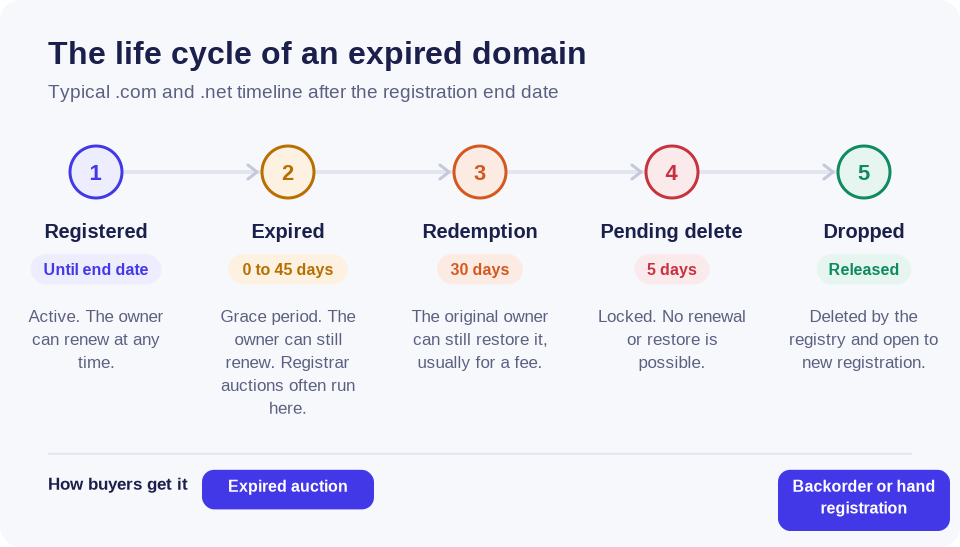
Unlike a brand-new domain, an expired domain may come with a history:
- Backlinks from external websites
- Previously published content
- Organic keyword rankings
- Brand mentions and citations
- Referral traffic
- Ownership and website changes over time
Some of these assets may still be useful after the acquisition. Others may have disappeared or become irrelevant.
Important: buying an expired domain does not automatically transfer its previous rankings, traffic or SEO value.
Expired, expiring, auction: what's the difference?
| Domain type | Meaning |
|---|---|
| Expiring domain | Registration is approaching expiration or has expired, but the previous registrant may still be able to renew it |
| Expired auction domain | A registrar or marketplace offers the domain through an auction process |
| Pending-delete domain | A domain approaching deletion under the registry lifecycle |
| Dropped domain | A previously registered domain that has been deleted and may be registered again |
| Aged domain | A domain with an established registration or website history, expired or not |
The distinction matters because purchasing methods, availability and pricing vary. An auction domain may attract several bidders, while a dropped domain could be available at a standard registration fee.
Why buy an expired domain?
There are several legitimate reasons:
- Launching in an established niche. A domain that previously hosted a technology blog may suit a new technology publication, if its history is clean and its backlinks come from credible sites in that field.
- Acquiring a memorable name. A short, recognizable name can help brand recall and direct navigation, even with no meaningful backlink profile.
- Rebuilding a discontinued resource. A domain that hosted a useful resource can be the base for a similar website with updated, original content.
- Expanding an existing business. Any redirects should serve users and point to equivalent or closely related pages.
In every case, a domain's historical reputation should not be confused with guaranteed future rankings.
When evaluating a candidate, focus on five things together:
- Relevance: does its previous purpose fit the website you're planning?
- Backlinks: are legitimate, relevant websites still linking to it?
- History: was it used consistently, or did it pass through questionable projects?
- Brand potential: is the name suitable for a website you would actually want to build?
- Price: does the acquisition make sense once development and content costs are included?
These factors matter more together than any single SEO score.
Don't let Domain Rating make the decision for you
Domain Rating (DR), Domain Authority (DA) and similar metrics are useful for quickly comparing backlink profiles. But they're not Google metrics, and none of them can tell you whether a domain will rank after you buy it.
Consider two domains for a new cycling publication.
Domain A
- Domain Rating
- 55
- Referring domains
- 340
- Previous website
- Several unrelated projects
- Backlink sources
- Directories and mixed-topic websites
- Anchor text
- Heavily optimized
- Historical content
- Repeated topic changes
- Intended new website
- Cycling publication
Domain B
- Domain Rating
- 22
- Referring domains
- 85
- Previous website
- Independent cycling blog
- Backlink sources
- Cycling magazines, clubs and blogs
- Anchor text
- Mostly branded and natural
- Historical content
- Consistent for six years
- Intended new website
- Cycling publication
Domain A looks stronger on paper. Domain B has a more coherent history, with backlinks that make sense for the planned website. We'd investigate Domain B first.
That doesn't mean the lower-DR domain will automatically perform better. It simply gives you a more convincing reason to consider buying it.
The lesson: use authority metrics to find candidates, then use actual evidence to decide which ones deserve your money.
Look at what the website used to be
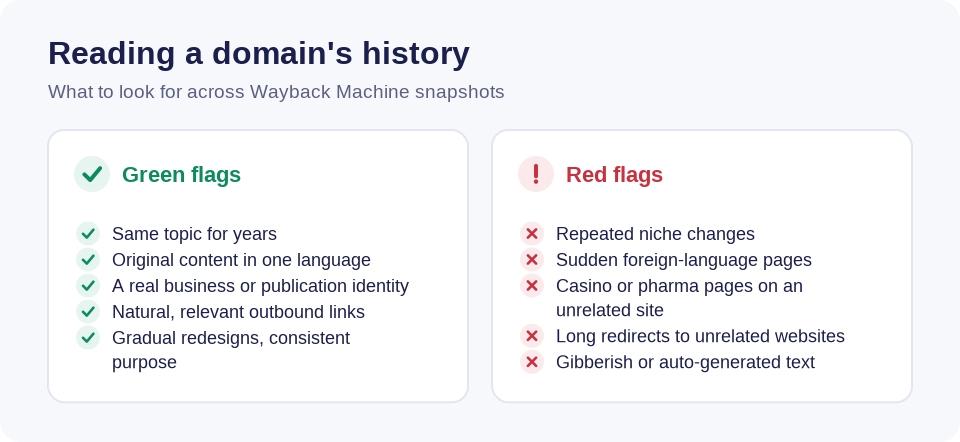
Before analyzing anything else in detail, open the domain in the Wayback Machine. You want to understand the website's story: was it a real business, an active blog, a local organization? Or was it repeatedly repurposed to publish unrelated content?
Don't inspect just one archived screenshot. Review several snapshots across different years, especially:
- The earliest available captures
- The years when the website was most active
- Major redesigns or changes of ownership
- Changes in content language
- The final archived versions before expiration
Imagine finding a domain with this history:
- 2017 to 2020Healthy
A legitimate travel blog with original destination guides.
- 2021Unclear
The website disappears.
- 2022Suspicious
It returns with hundreds of unrelated casino and pharmaceutical pages.
- 2023Suspicious
It redirects to another website.
- 2025Expired
The domain expires.
Hypothetical example.
The original travel blog might explain why the domain earned some valuable backlinks. But its later history raises questions. Was it hacked? Was it sold and repurposed? Were the backlinks artificially manipulated? You may not be able to answer every question, but the uncertainty should influence your decision.
Warning signs in historical snapshots
- Repeated niche changes without a clear reason.
- Foreign-language spam: unrelated content in another language may mean the site was repurposed or compromised.
- Doorway pages: hundreds of near-identical pages targeting keyword variations.
- Hacked content: unexpected pharmaceutical, gambling or malware-related pages.
- Repeated redirects to unrelated websites over long periods.
- Link network patterns: thin posts, unnatural outbound links, generic templates and frequent topic changes.
Not every change is evidence of spam. Companies rebrand, websites get acquired and legitimate projects evolve. What matters is whether the history makes sense.
And remember: the Wayback Machine doesn't capture every page or every point in time. Missing archives are not proof of a clean history.
Check the backlinks, not just the backlink count
This is where many buying decisions go wrong.
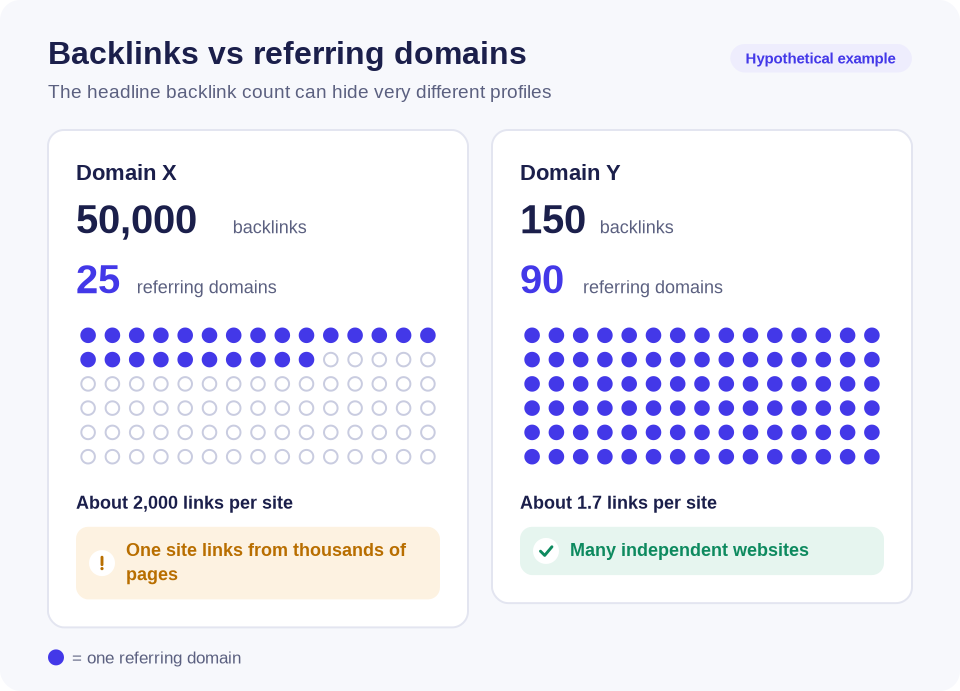
A domain might have 50,000 backlinks but only 25 referring domains, because a single website linked to it across thousands of pages. Another might have 150 backlinks from 90 independent, relevant websites. These two situations are very different.
Start with referring domains (the number of unique websites linking to the domain).
Then open the pages providing the strongest backlinks and ask:
- Is the linking website legitimate and actively maintained?
- Is its content relevant to the domain's historical subject?
- Does the link appear naturally within useful content?
- Is the linking page still accessible, and is the link still there?
- Is the link editorial, sponsored, user-generated or otherwise qualified?
Above all: would this website have a genuine reason to link to the old domain? A cycling magazine linking to a former cycling blog's research article makes sense. An unrelated coupon website linking with the anchor "best online loans" deserves more attention.
Look for editorial links
Useful signals include links from established niche publications, relevant industry blogs, professional associations, universities and research organizations, genuine local businesses, and independent journalists.
These aren't automatic endorsements. A university link can still be irrelevant or compromised. Always check the surrounding content: the best backlinks are understandable in context.
Are those backlinks still live?
Historical backlink reports don't always reflect what exists today. A domain showing 200 referring domains today might once have had 800. The important question is why those links disappeared: removed mentions, deleted websites, changed destination pages, or a collapse of the most authoritative references.
Homepage or internal pages?
Suppose a domain earned most of its quality links through an industry report published at:
example.com/research/market-report
If you buy the domain and publish a completely different website, those links won't automatically become useful. You would need to assess whether a new, original resource could genuinely serve the same audience and search intent. Don't recreate copyrighted content, and don't assume that redirecting every old URL to your homepage will preserve its previous value.
Read the anchor texts
Anchor text (the clickable text of a link) reveals a surprising amount about a domain's past. A legitimate website usually earns a mix of:
- The publication's name
- The domain name
- Generic phrases such as "read the full report"
- References such as "according to this study"
- The title of an article
Now imagine a former technology website whose backlink profile is dominated by unrelated commercial anchors about gambling bonuses, loans or pharmaceuticals. That doesn't immediately prove the domain is bad, but it tells you the profile needs closer examination.
Look for patterns rather than individual links. A handful of unusual anchors may be harmless. Hundreds of nearly identical commercial anchors across unrelated websites are much harder to explain. Also check language consistency, and whether links appeared gradually or in large, unexplained bursts.
The objective isn't a mathematically perfect anchor distribution. It's to understand how and why other websites linked to the domain.
Understand SEO metrics without overvaluing them
Most authority scores are proprietary metrics created by third-party companies, not Google ranking scores.
| Metric | What it helps evaluate | Main limitation |
|---|---|---|
| Ahrefs Domain Rating (DR) | Relative backlink profile strength | Doesn't guarantee traffic or rankings |
| Moz Domain Authority (DA) | Estimated ability to rank relative to other sites | Predictive third-party metric |
| Majestic Trust Flow (TF) | Link proximity to trusted seed sites | Doesn't establish overall website quality |
| Majestic Citation Flow (CF) | Link quantity and influence | Can be inflated by low-quality links |
| Semrush Authority Score (AS) | Composite measure of quality and influence | Must be read alongside underlying data |
| Referring domains | Number of unique linking domains | Doesn't measure editorial quality on its own |
| Estimated organic traffic | Possible search visibility | Estimates may differ from real analytics |
Is there a minimum DR worth buying?
No. A DR 10 domain with a clean history, relevant branding and strong niche links may be useful. A DR 60 domain with a spam history and unrelated backlinks may be a poor investment.
Instead of a fixed score, set minimum quality criteria: a coherent past, real and relevant referring websites, natural anchors, a usable name, a viable content strategy and an acceptable price.
Investigate historical traffic and rankings
Tools such as Ahrefs and Semrush can show previous keyword rankings and estimated organic traffic. Review several years rather than one recent figure.
Estimated traffic is not the same as verified website traffic. These tools use their own databases and models. They may miss keywords or overestimate visibility.
What matters is the overall pattern. A domain that ranked for relevant keywords over several years was probably an established resource in its niche. If its strongest keywords were unrelated to its apparent content, for example rankings driven by hacked pages, something changed.
What about a sudden traffic drop?
A sharp decline is worth investigating, but don't immediately assume a Google penalty. Possible causes include content removal, a migration, technical problems, lost backlinks, algorithm updates, lower search demand, or a spam-related issue.
Without the previous owner's Search Console data, you usually can't determine the cause with certainty. Treat an unexplained decline as a research question, not as proof of a penalty.
Check indexing and Google's expired domain abuse policy
Search for the domain in Google and inspect any remaining indexed URLs with the site: operator:
site:example.com
This operator is neither a complete index report nor a penalty detector. A domain with no results may simply have been offline for a long time, and one that appears in results isn't automatically free of problems.
More importantly, Google has a specific policy on expired domain abuse. Purchasing an expired domain and repurposing it primarily to manipulate search rankings with content that provides little or no value to users is considered spam. You can read it in Google Search Central's spam policies.
This doesn't mean every expired-domain purchase is a problem. The distinction is what you build and why. Acquiring a former photography blog and developing a genuinely useful photography publication is different from taking an old educational domain and filling it with unrelated, low-quality commercial pages.
Before purchasing, ask yourself:
Would I still want to build this website if the domain had no historical SEO advantage?
If the answer is yes, you're treating the domain as a business or publishing asset. If the answer is no, reconsider the strategy.
Check whether the name is actually usable
A domain can have great links and still be a poor business decision. The name may belong to an old registered company, be hard to pronounce, contain an awkward hyphen or be too close to another brand.
Before buying, look into:
- Trademark conflicts in your target markets (USPTO, EUIPO or WIPO databases, depending on the market)
- Previous business names associated with the domain
- Existing companies using similar names
- Risks of impersonation or consumer confusion
- Domain extension and renewal fees
- Whether the name fits your future content and audience
Buying a domain doesn't grant ownership of the previous website's articles, images, logos or trademarks. A simple, memorable name with a clean history can be worth more than a higher-authority domain that is difficult to reuse.
How much should you pay?
There isn't a universal price for a good expired domain. Some cost little more than a standard registration fee. Competitive auction domains can cost hundreds, thousands or considerably more.
The relevant question isn't whether the domain looks cheap compared with its DR. It's whether the purchase makes sense for your project.
| Expense | Illustrative budget |
|---|---|
| Expired domain | $400 |
| Website setup and development | $600 |
| Initial editorial content | $1,500 |
| Hosting and technical tools | $200 |
| Initial investment | $2,700 |
Hypothetical figures, not market averages.
The domain is only part of the investment. If you spend your entire budget on it, even an attractive acquisition can become a poor decision.
Price, quality and relevance must be evaluated together:
| Criterion | Domain A | Domain B | Domain C |
|---|---|---|---|
| Acquisition price | $150 | $450 | $1,200 |
| Domain Rating | 45 | 28 | 60 |
| Topical history | Unrelated topics | Consistent niche | Several changes |
| Backlink quality | Questionable | Strong editorial links | Mixed |
| Brand potential | Low | High | Medium |
| Overall assessment | Avoid | Strong candidate | Needs more research |
Hypothetical example.
Before joining an auction, set a maximum price, include a margin for what you cannot verify, and count the time you'll need to build, maintain and promote the website. Be prepared to walk away: there will always be other domains.
A step-by-step evaluation process
- Define the project: audience, market, content categories and business model.
- Build a shortlist from auctions, marketplaces or discovery tools, filtering out irrelevant names and extensions.
- Review historical snapshots across several years and reject serious unexplained spam histories.
- Analyze referring domains: quality of the strongest links, relevance and lost links. Open them manually.
- Review anchor texts for natural branding and unusual commercial concentrations.
- Analyze past search visibility and investigate unexplained declines.
- Review the strongest historical URLs and whether equivalent original resources would make editorial sense.
- Check legal and brand compatibility.
- Calculate the full budget: price, renewals, content, development and running costs.
- Document your decision: the evidence for the purchase and the remaining uncertainties. It should be explainable without citing an authority metric alone.
Your checklist before buying
What you're looking for: A recognizable website with a coherent purpose
Warning signMultiple unexplained topic changesWhat you're looking for: Content history related to the new project
Warning signCompletely unrelated previous useWhat you're looking for: No serious unresolved concerns
Warning signHacked pages, doorway pages, foreign-language spamWhat you're looking for: Genuine, active websites
Warning signLarge numbers of low-quality sourcesWhat you're looking for: Natural editorial references
Warning signArtificial-looking link placementsWhat you're looking for: No unexplained collapse of key references
Warning signMost strong links removedWhat you're looking for: Branded and relevant phrases
Warning signExcessive unrelated commercial anchorsWhat you're looking for: Relevant search visibility
Warning signSuspicious or unrelated keyword patternsWhat you're looking for: Pages that make sense historically
Warning signValuable links pointing to irrelevant URLsWhat you're looking for: A name you can legitimately use
Warning signTrademark or impersonation risksWhat you're looking for: Compatible with a realistic budget
Warning signBidding based on DR aloneWhat you're looking for: Original and genuinely useful
Warning signNo sensible use without the SEO history
A domain doesn't need a perfect result on every line. But serious concerns about spam history, legal ownership or backlink authenticity should outweigh attractive headline metrics.
Three decision categories
Rather than assigning a magic score to every domain, sort candidates into three groups:
- Worth investigating: the domain looks relevant, its history is understandable and its backlink profile contains genuine opportunities.
- Needs more research: useful signals, but unresolved concerns about historical content, link quality or price.
- Avoid: major spam indicators, suspicious link patterns, serious trademark concerns, or no sensible use for the domain.
Common mistakes when buying expired domains
- Buying only because the DR is high. A third-party score cannot replace a history and backlink review.
- Ignoring old website content. A domain that looks fine today may have hosted several unrelated projects.
- Assuming all backlinks are still active. Historical counts include links removed years ago.
- Overestimating previous traffic. Past estimated visibility doesn't guarantee future traffic.
- Changing the niche without a reason. A major topic change can make existing links and audience irrelevant.
- Rebuilding copyrighted content. Owning the domain doesn't include rights to old texts, images or branding.
- Ignoring ongoing costs. Content, maintenance and promotion can cost more than the domain itself.
What happens after you buy the domain?
Acquiring the domain is only the beginning. Start with a clear editorial positioning: what the website will cover, who it's for, and what value it offers that existing websites don't.
From there:
- Configure reliable hosting, HTTPS and DNS.
- Review indexing settings and robots.txt.
- Review historical URLs with significant backlinks.
- Plan a logical website structure and internal linking.
- Publish original content and clear business and editorial information.
- Set up Google Search Console and analytics.
- Monitor indexing, impressions, clicks, crawl errors and backlink changes.
Don't feel obliged to recreate every historical page, and avoid creating misleading pages solely to capture old backlinks. Prioritize resources that make sense for your new project.
If you plan to monetize, think about revenue early: advertising, subscriptions, affiliate partnerships or appropriately disclosed sponsored content can all be legitimate. The site should remain useful beyond its monetization model.
Tools to research expired domains
Evaluating domains manually takes time, especially when you're comparing dozens or hundreds of candidates. A combination of tools makes it manageable:
- Wayback Machine: reviewing historical versions and major content changes.
- Ahrefs: backlinks, referring domains, anchor text and historical organic visibility.
- Semrush: backlink analysis, Authority Score, keywords and estimated traffic.
- Majestic: link intelligence metrics such as Trust Flow and Citation Flow.
- Domain auction marketplaces: platforms such as GoDaddy Auctions, NameJet and DropCatch, each covering different acquisition processes.
No tool can guarantee that a domain is safe or that it will perform well in search. The most reliable process is still to combine data from several sources with your own assessment.
Final thoughts
It's easy to get distracted by impressive SEO numbers. A DR of 50 looks good in a spreadsheet. Hundreds of referring domains sound promising. A 15-year-old registration can make a domain seem established.
But none of those facts, on its own, tells you whether a domain is worth buying. Before making a purchase, answer three questions:
- Is the domain's history trustworthy?
- Are its existing backlinks genuinely relevant and still live?
- Can you build a useful, sustainable website on it?
If you can answer all three confidently, you may have found an interesting opportunity. If you can't, a brand-new domain might be the better investment.
A good expired domain isn't a shortcut to rankings. It's a potentially useful foundation for a website that's worth building.
Ready to dominate
competitive SERPs?
Join Orbink and claim a $20 welcome bonus. Browse sites with their metrics and prices before you order.
No credit card required to sign up. $20 welcome bonus credited on your first order of $50 or more, or on your first top-up, if claimed within 30 days of signup.
Frequently Asked Questions
No. Buying an expired domain doesn't transfer its previous rankings or traffic. Search engines assess the current website, its content and its links.
No. DR is a third-party metric. A low-DR domain with a clean history and relevant links can be more useful than a high-DR domain with a spam history.
Not in itself. Google's expired domain abuse policy targets domains repurposed primarily to manipulate rankings with low-value content. Building a genuinely useful website on an expired domain is a different situation.
Review several Wayback Machine snapshots across different years, then compare with backlink, anchor text and historical traffic data. Missing archives are not proof of a clean history.
There is no standard price. Set a maximum before bidding, based on the domain's relevance, link quality and brand potential, and on the full cost of building the website.
Sources
